
Referring is simple to describe and easy to get wrong. This guide covers the whole job, from how the market works to what happens after you make an introduction. It uses the micro1 company referral as the worked example, and it applies to any programme with a published referral scheme: Mode, Mercor and Handshake AI too.
01How a micro1 referral works, on one page
A company referral has five steps, and your part ends at the introduction.
From how the market works to what happens after you make an introduction.
1. Market
Why it exists
- ✓AI labs want to see how real work gets done
- ✓That sits in company records
- ✓Programmes license those records
- ✓Most owners don’t know this yet
2. Fit
Who to approach
- ✓Established companies
- ✓Desk staff, not just headcount
- ✓Several systems in use
- ✓Rights to the records
3. List
Who to contact
- ✓Start with people you know
- ✓Then one industry you understand
- ✓Find the decision maker
- ✓Verify every address
4. Outreach
What to say
- ✓Plain words, short messages
- ✓Published ranges, with the source
- ✓Say you may earn a fee
- ✓Reply quickly
5. Handover
What happens next
- ✓They apply through your link
- ✓The programme evaluates
- ✓You don’t handle any data
- ✓Track status in the dashboard
What you do
The referrer’s side
What the programme does
Everything after the introduction
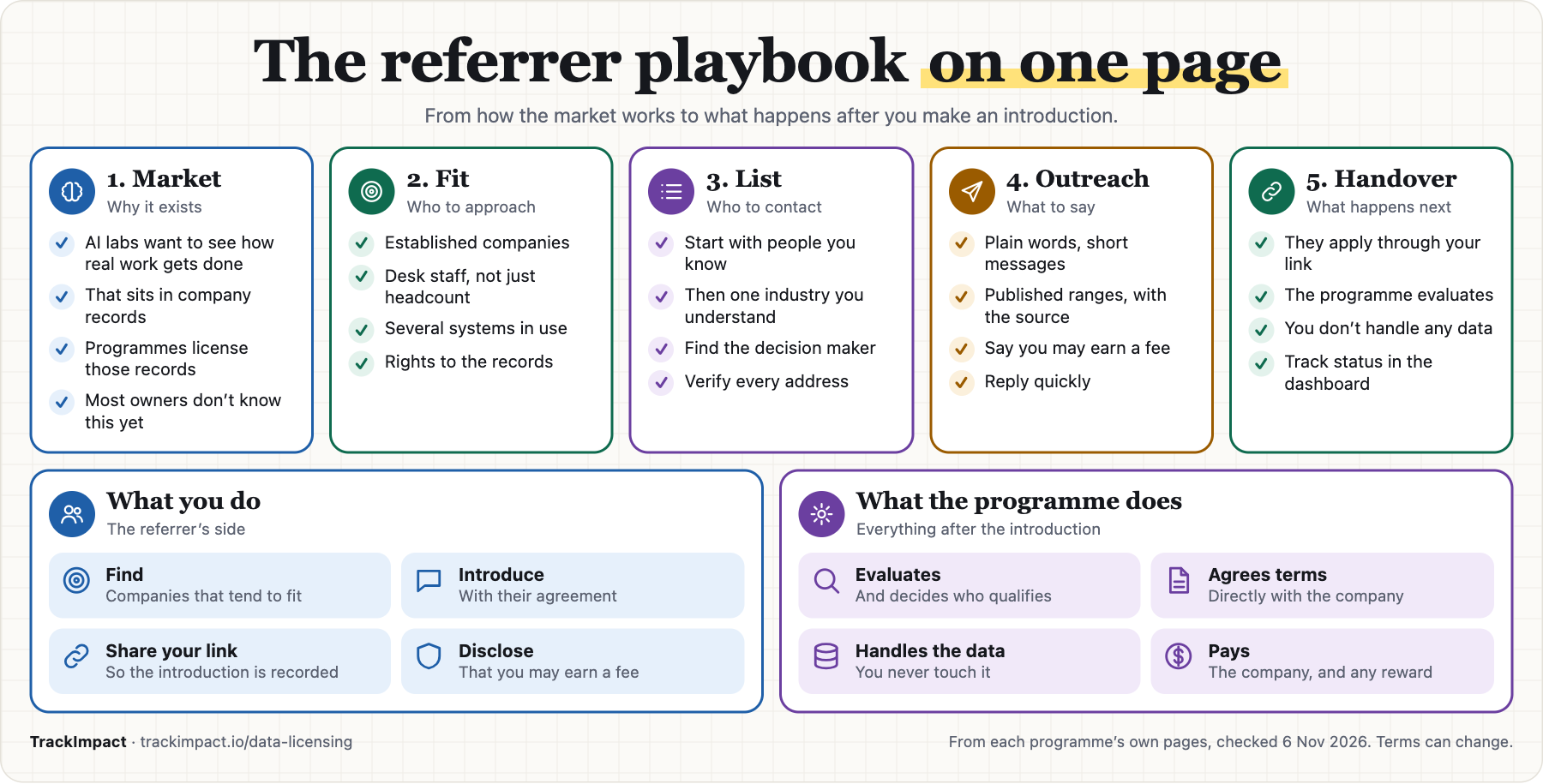
- Market: AI labs want records of how real work gets done, and those sit inside companies.
- Fit: you approach established companies with desk staff, several systems and rights to their records.
- List: you start with people who know you, then one industry you understand.
- Outreach: you write in plain words, quote published ranges with the source and say you may earn a fee.
- Handover: the company applies through your link and the programme evaluates it. You never handle its data.
The sections below take each part in turn. For micro1's own figures, terms and dates in one place, see the micro1 referral program explained.
02Why AI companies pay for company data
AI models learned to write from public text. The programmes now want models that can do real work, and how work gets done sits inside companies: in process documents, tickets, project histories and the messages between them.
AI models learned to write from public text. Doing real work takes something else.
What models learned from
The public web
What they need now
How work actually moves
The money is published
From the programmes’ own pages
Ranges, not offers. What any company receives depends on its records and the programme’s review.
Why owners don’t know
The opening for a referrer
- ✓Company data licensing is new
- ✓Old records look like clutter
- ✓Nobody has told them it has value
- ✓They hear about it first from someone they trust
The closest public comparison
A failed company’s internal records
In August 2026, Google won a bankruptcy auction for Spirit Airlines’ internal emails, chat and files with a $10M bid, with court approval pending when last checked. It showed buyers will pay for how a company ran.
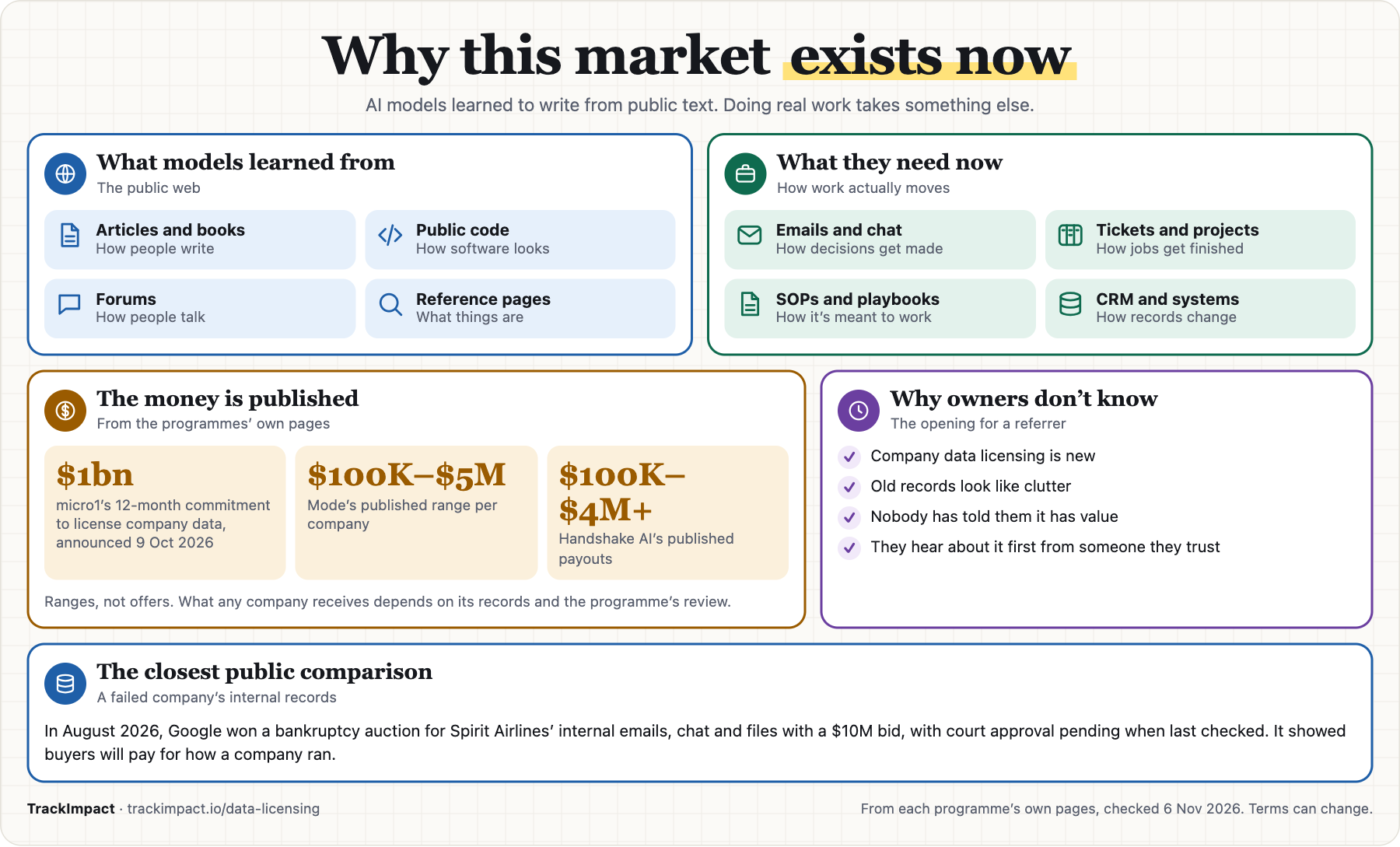
So programmes license those records from established companies. The closest public example: in August 2026, Google won a bankruptcy auction for Spirit Airlines' internal records with a $10M bid. For more, see what AI data deals have been reported.
Most owners have never thought of their old records as an asset. That's the opening for a referrer: you're telling them about something they may not know exists, then letting them decide.
03Who pays the referral fee?
The programme pays the company for its data. Separately, it may pay you a reward for the introduction. The company never pays you.
Two separate payments, both from the programme. The company never pays you.
How the money moves
One introduction, two payments
When a reward is earned
Each programme sets its own trigger
| Programme | Earned | Paid |
|---|---|---|
| micro1 | After data is transferred and approved | After payout approval, by bank wire |
| Mode | When the partnership qualifies | Final terms apply |
| Mercor | When the company signs its licence | After first delivery |
| Handshake AI | Not confirmed | Not confirmed |
Walk away if
That’s a different arrangement
- ✕Anyone asks the company for a fee to get in
- ✕Anyone wants a deposit
- ✕Anyone wants a share of the company’s payment
- ✕Anyone promises a figure before a review
What to tell people
Every time, in plain words
“I may earn a referral fee from the programme if your company takes part. It costs you nothing.”
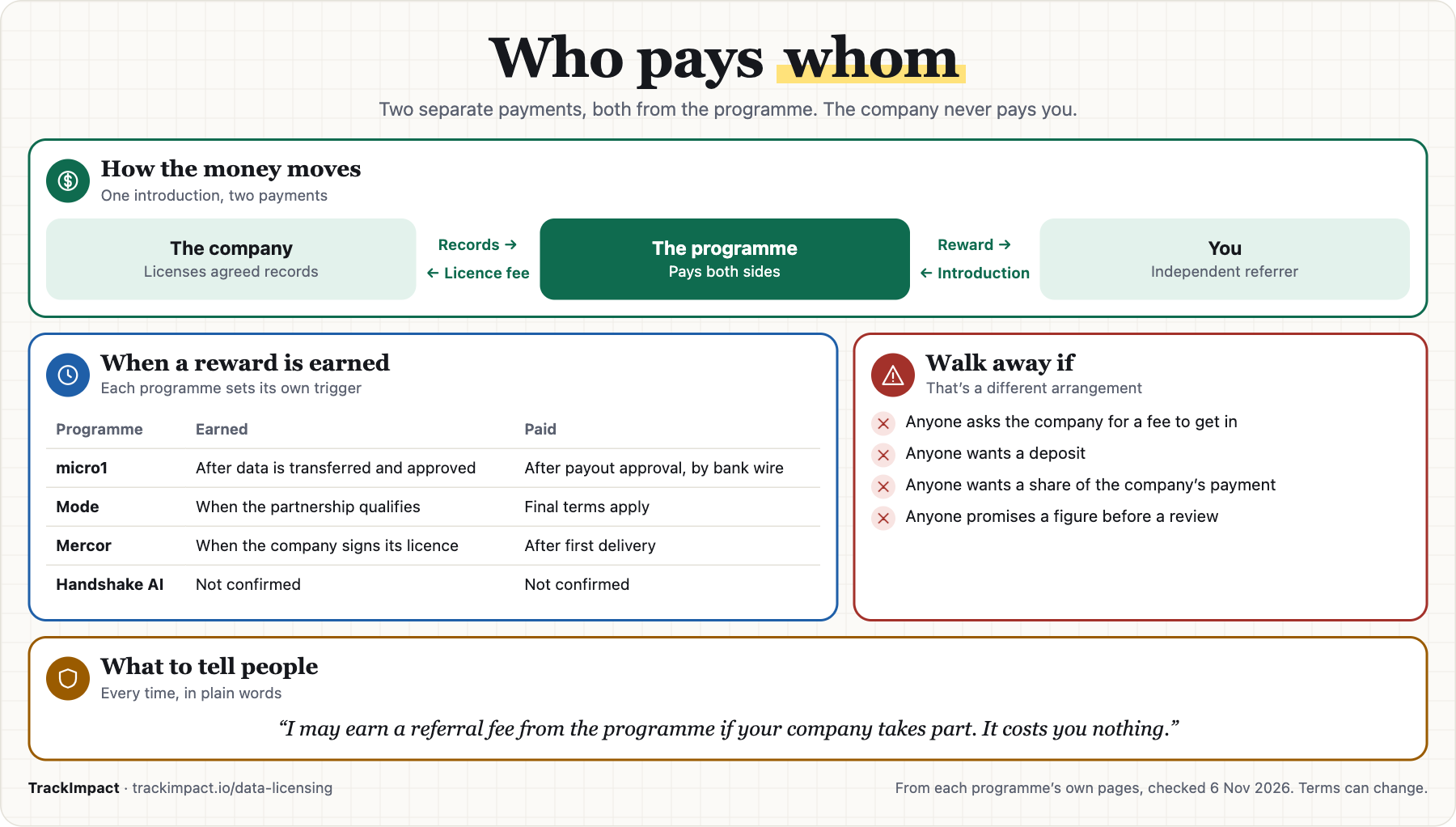
If anyone asks a company for a fee to "get in", that's a different arrangement. Our page on how referral fees work has the detail.
04micro1, Mode, Mercor and Handshake AI referral programs compared
Don't tie yourself to one programme. They want different companies, they pay differently, and any of them can change its terms.
Don’t tie yourself to one. They want different companies, and any of them can change its terms.
Published company ranges
On one scale, from each programme’s own pages
Ranges, not offers.
What each one publishes
Referral terms and who it looks for
| micro1 | Mode | Mercor | Handshake AI | |
|---|---|---|---|---|
| Looks for | 30+ employees, English records | 10+ legal; 15+ accounting, medical, finance; 50+ others | Per business type | 20+ full-time, 3+ years |
| Where | US and Western markets | US, Canada, UK, Australia | Per business type | Not confirmed |
| Referral reward | $50,000 for deals up to $700,000, or 7.5% above that | “$50,000+”, proposed, final terms apply | Per business type, up to $100,000 | Terms not confirmed |
| Closed companies | $75,000 for deals up to $1 million, or 7.5% above | Not published | Not published | Not published |
| How you’re credited | Company registers through your link | Company uses your link | Referral code when applying | Not confirmed |
Before you start
A minute on each programme’s site
- ✓Join each scheme you want to use
- ✓Read its current terms
- ✓Save your company referral link
- ✓Check for new programmes
These can change
Treat every figure as dated
- ✕No programme guarantees a reward
- ✕No range is an offer
- ✕Terms can change without notice
- ✕A company may suit one and not another
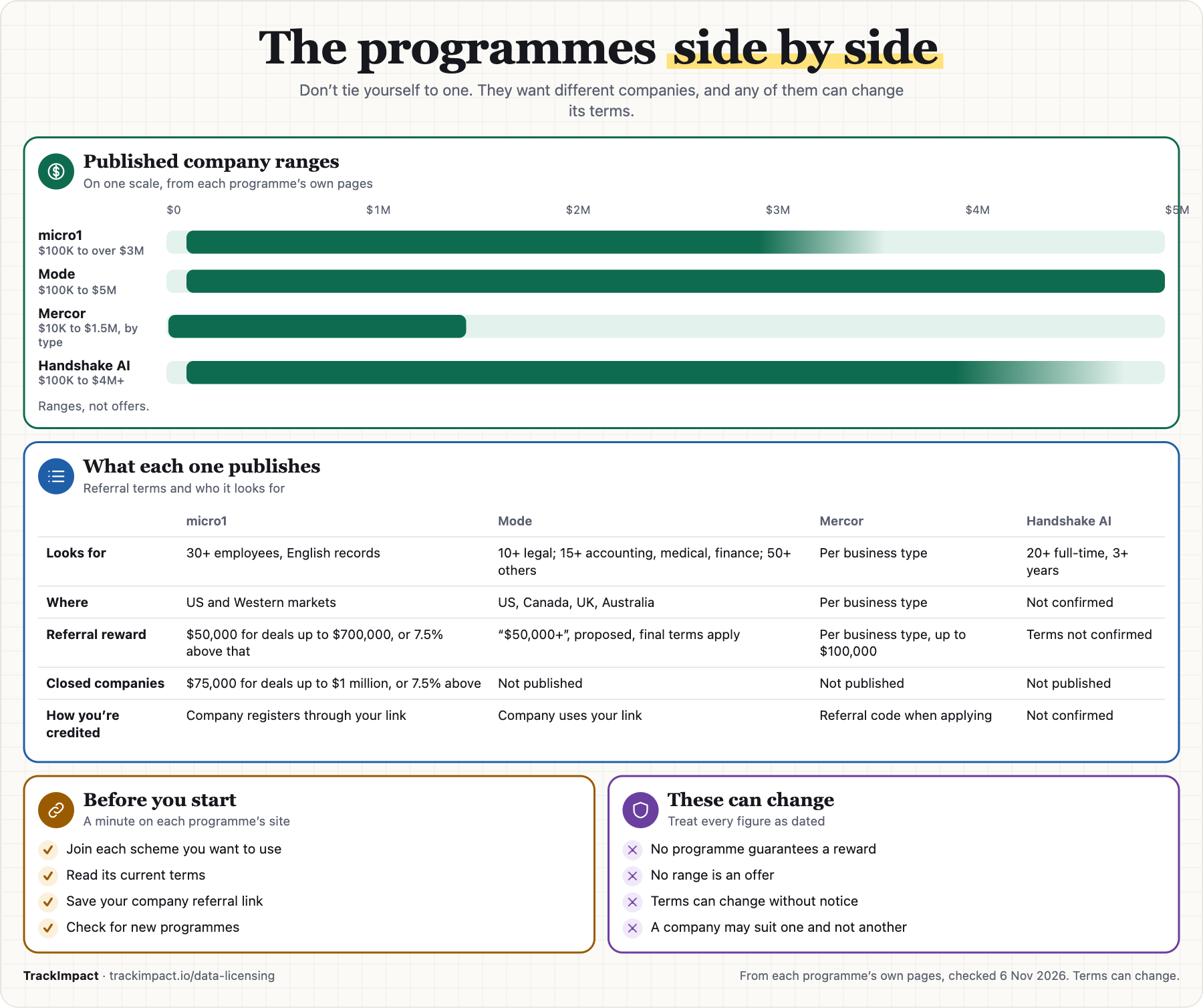
| micro1 | Mode | Mercor | Handshake AI | |
|---|---|---|---|---|
| Published company range | $100K to over $3M | $100K to $5M | $10K to $1.5M, by business type | $100K to $4M+ |
| Who it looks for | 30+ employees, US and Western markets, English records | 10+ legal; 15+ accounting, medical, finance; 50+ others | Per business type | 20+ full-time employees, 3+ years |
| Published referral reward | $50,000 for deals up to $700,000, or 7.5% above that | "$50,000+", proposed, final terms apply | Set per business type, up to $100,000 | Has a referral page; terms not confirmed |
| Details | micro1's scheme | Mode's scheme | Mercor's scheme | Handshake AI |
These are the programmes' own figures. They can change, and none of them is a promise. New programmes appear often, so check the programmes page before you start.
05Which companies qualify for a referral?
Look at the published criteria, then use your judgement about who to approach.
What AI data programmes publish, in one place. Each programme makes its own decision.
What they look for
Common across the programmes
- ✓Enough staffFrom 10+ to 50+, by programme
- ✓The right marketMainly US, UK, Canada, Australia
- ✓Years of historyMore history means more records
- ✓Several systemsEmail, chat, files, projects, CRM
- ✓English recordsMostly written in English
- ✓Rights to the recordsTheirs to license
Minimum staff, by programme
Each programme’s published starting point
Mercor sets its criteria per business type, so it isn’t on this scale.
Where the records live
The tools a company uses show what it holds
Count the desks
Example: a company of 400 people
Good places to start
Desk-heavy industries with years of records
Your job stops here
Leave the decision to the programme
- ✕Don’t tell a company it qualifies, or that it doesn’t
- ✕Don’t give a figure for their company
- ✕Don’t collect their data, files or logins
- ✕Don’t refer anyone without their agreement
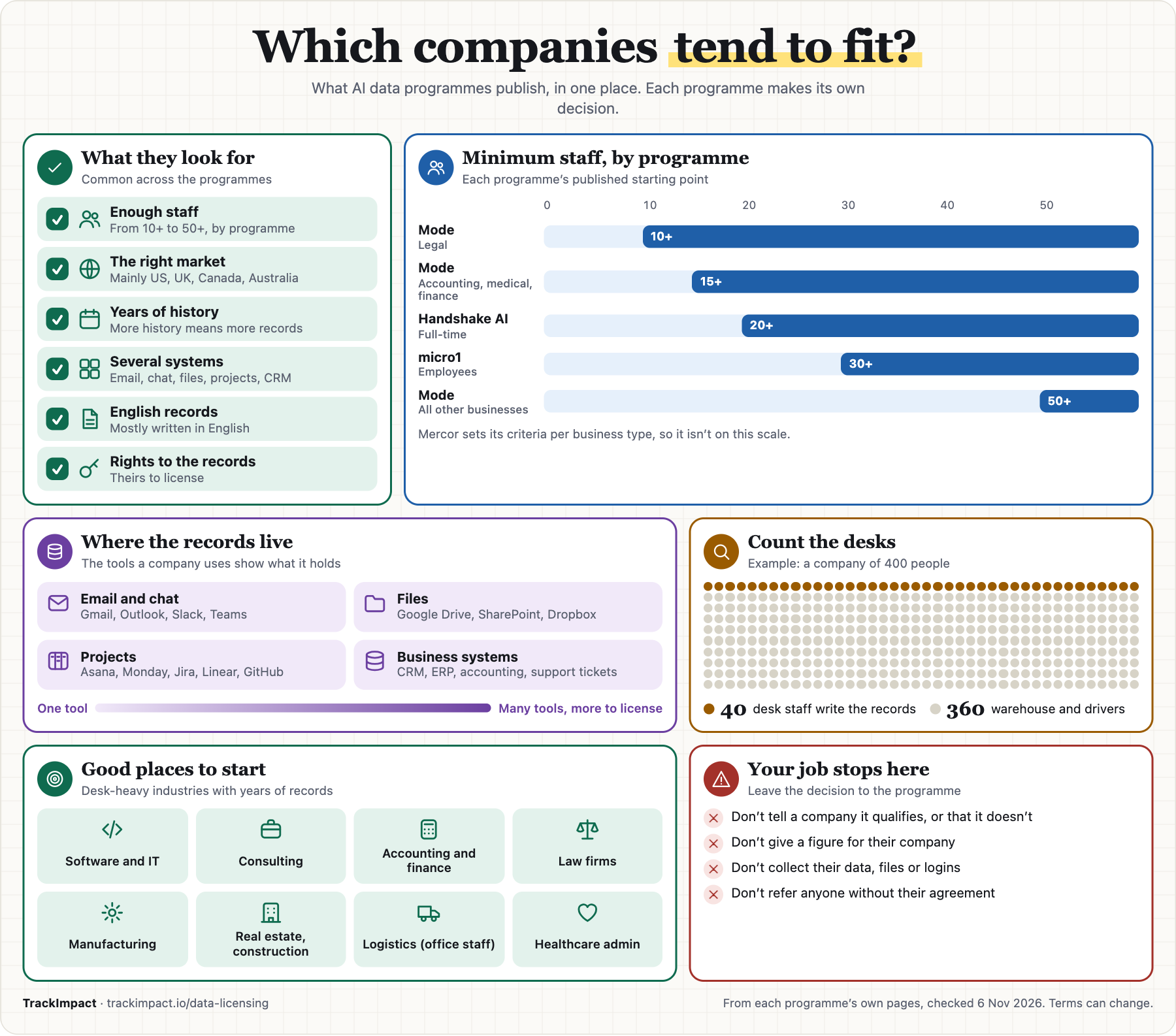
Count desk staff rather than total headcount. A logistics firm with 300 drivers and 15 office staff has 15 people producing the kind of records programmes look for. Companies with several systems tend to hold more, and years of history help.
Share the criteria, but don't act as the gatekeeper. Never tell a company that it qualifies or that it doesn't. Point it to the fit check and let the programme decide.
06Warm introductions: accountants, consultants and IT providers
Your warmest introductions are your best ones. Accountants, consultants, IT providers, M&A advisers and peer-group chairs already have trust with owners. If you're in a regulated profession, read what professional advisers should check first.
Get the person's agreement before you refer their company, and keep a note of it. Then send your link and let them apply themselves.
07Building a list of companies to refer
When your own network runs out, the work becomes list building.
Start with people who know you. When that runs out, it becomes a list-building job.
Six steps
Finish one industry before you start a second
- 1One industryOne you understand
- 2Size and placeUse published criteria
- 3Their toolsJob adverts show them
- 4Desk staffCount office roles
- 5Decision makerWho can say yes
- 6VerifyEvery address, first
Your warmest list
Before you buy any data
Where to look
Examples of what each one shows
Who can say yes
Usually, by company size
One good row
An invented example of what to record
| Company | Staff | Desk | Tools seen | Contact | |
|---|---|---|---|---|---|
| Example Ltd | 120 | 60 | Jira, Slack, Salesforce | COO | Verified |
Skip for now
Not a ruling, just where to start
- ✕Companies that may not own their records
- ✕Very few desk staff
- ✕Mostly non-English records
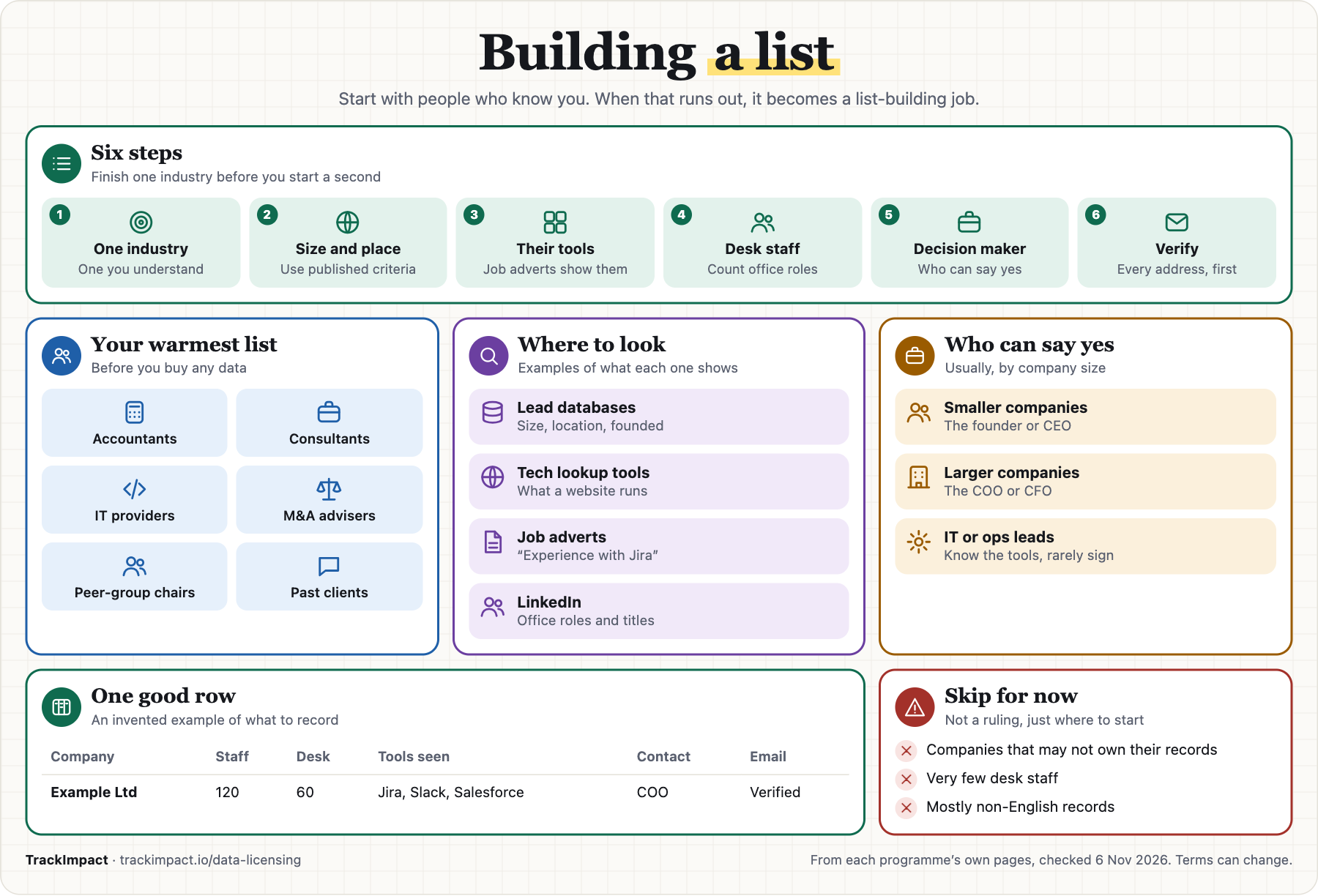
Pick one industry you understand. You'll be taken seriously much faster if you can talk about the systems that industry runs on. Filter a lead database by size and location, and use job adverts to spot tools: an advert asking for Jira and Salesforce experience tells you two of them.
Then find the person who can say yes. That's usually the founder or CEO in a smaller company, and the COO or CFO in a larger one. Verify every address before you send, because bounced emails damage your sending reputation.
08What to say: referral outreach that follows the rules
Short messages in plain words work best. Say what the records are, what the range looks like and what the next step is.
Short messages in plain words. Say what it is, what the range looks like and what happens next.
Say
Plain and accurate
- ✓License your records
- ✓Published ranges, with the source
- ✓I’m an independent referrer
- ✓I may earn a referral fee
- ✓The programme decides
Avoid
These cause problems
- ✕Sell your data
- ✕A figure for their company
- ✕Partner, agent or representative of a programme
- ✕Guaranteed anonymous
- ✕You qualify, or you don’t
A four-step sequence
A few days apart, and stop when someone asks
- 1IntroduceWhat it is, and the check
- 2Add detailTypical records, published ranges
- 3Ask whoIs someone else better placed?
- 4CloseNo more follow-ups
What a first email contains
Every part earns its place
Cold email basics
Rules vary, so check your own
- ✓Say who you are
- ✓Include a postal address
- ✓Give a way to opt out
- ✓Stop when asked
Make it relevant
Swap the examples for ones they’ll recognise
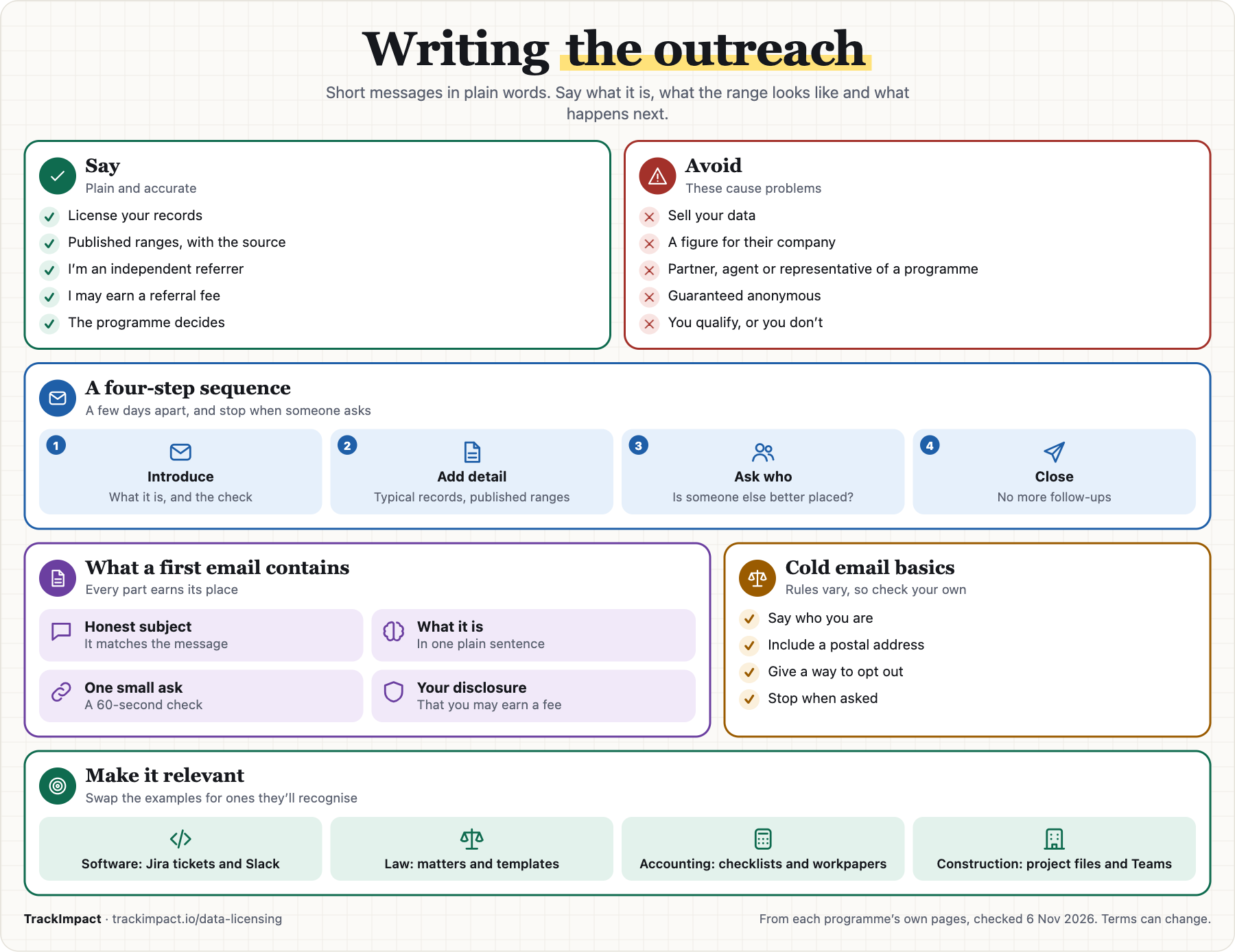
Three rules matter most. Tell people you may earn a fee, because the FTC's endorsement rules and the programmes' own terms expect you to be open about it. Present yourself as independent, and never as a partner, agent or representative of a programme. Never give a figure for their company.
Cold email has its own rules. In general, use a subject line that reflects the message, say who you are, include a postal address and a way to opt out, and stop when someone asks. The rules vary by country, so check the ones that apply to you.
The kit has every template ready to copy, with your link already in it: warm introductions, a four-step cold sequence, LinkedIn messages and replies.
09Answering a company's questions
Privacy comes up most. Answer honestly, and send people to the programme for anything specific.
Privacy comes up most. Answer honestly, and send people to the programme for anything specific.
“Our customer data?”
Point them to the agreement
Programmes are mainly after how work gets done. Identifying details are removed or transformed before data is shared, and the company decides what goes in.
“Are we selling it?”
Point them to the ownership clause
It’s a licence, and terms vary. micro1 says companies keep ownership of their underlying data. Check exclusivity and length before signing.
“In our systems?”
Point them to the programme’s process
The company transfers agreed data, so it’s a defined handover. Ask the programme how that works for its systems.
“Is this legitimate?”
Point them to the programme’s site
Programmes publish their terms and companies apply directly, so they can check for themselves. No genuine programme should charge to take part.
“What would we get?”
Point them to the fit check
Nobody can say until the programme has reviewed the records. Each one publishes a range, and the check gives an indicative view.
“What do you get?”
Say it straight
The programme may pay a referral fee. It costs the company nothing, and it’s free to apply directly instead.
How to reply well
Most of this is speed and honesty
- ✓Reply quickly to anyone interested
- ✓Lead with how work gets done
- ✓Say so if you don’t know
- ✓Send them to the source
Don’t guess
It’s not your contract
- ✕What a contract says
- ✕How anonymisation works in detail
- ✕Which AI lab gets the data
- ✕What their company would receive
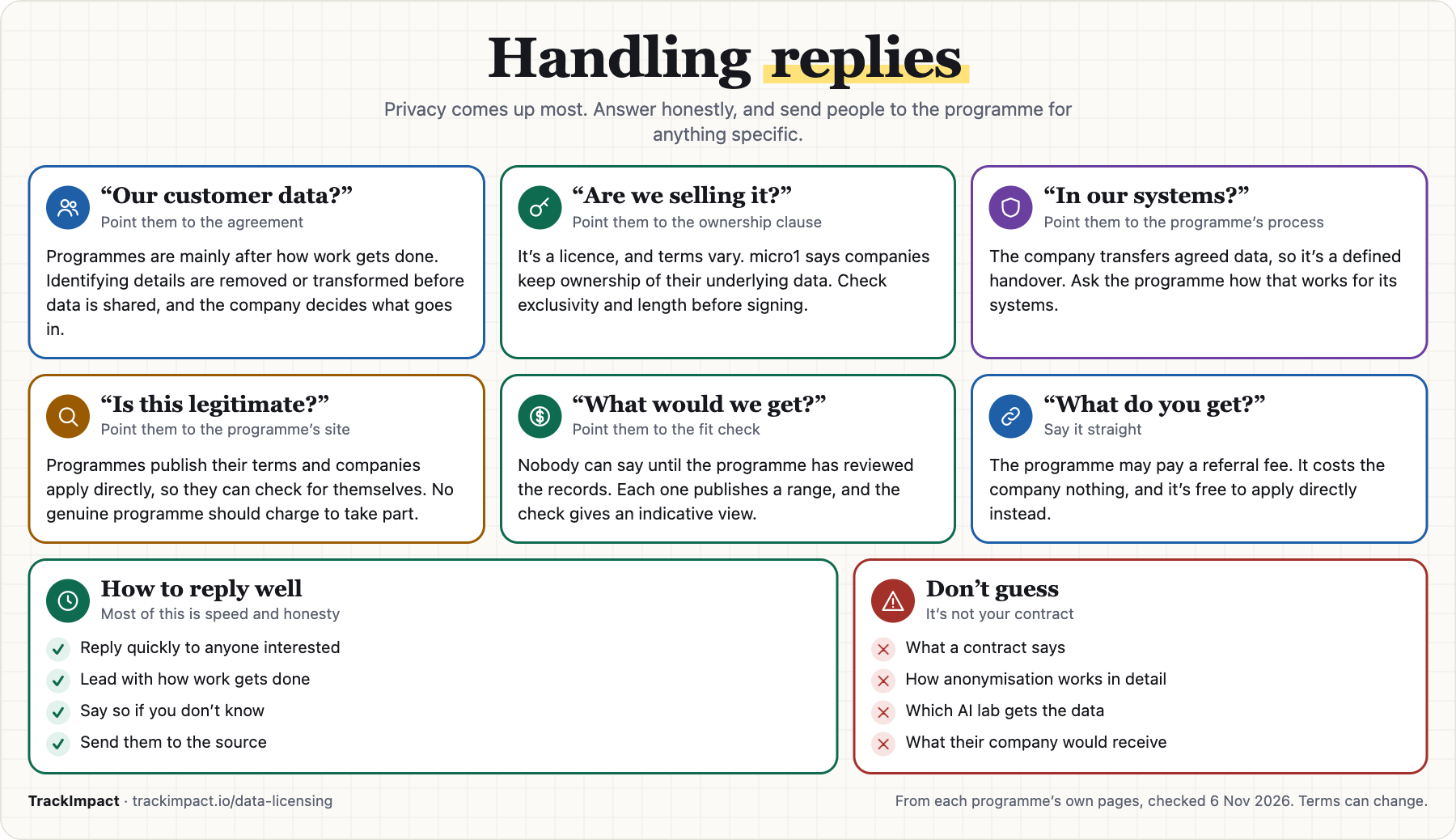
Reply quickly to anyone interested. If you don't know an answer, say so and point them to the programme. Don't guess at what a contract says.
10After the introduction: how micro1 referral attribution works
The company registers through your link, and from there the programme runs the process. You don't need to attend any calls, and you should never collect or forward the company's data, files or logins.
The company applies directly, and the programme runs the process from there.
What happens next
micro1’s published process. Other programmes differ
- 1RegistersThrough your link
- 2EvaluatedProgramme decides fit
- 3Data transferredApproved data only
- 4ReviewedUp to 30 days
- 5PaidWithin 30 days of invoicing
- 6Your rewardProcessed after approval
Protect your credit
Attribution depends on the link
- ✓Get their agreement first
- ✓Send your own link, not the plain page
- ✓Make sure they register through it
- ✓Ask whether they’ve already applied
Never
Your job ended at the introduction
- ✕Apply on the company’s behalf
- ✕Collect, hold or forward its data
- ✕Ask for logins or files
- ✕Share your reward with the company
Track every introduction
One row each. An invented example
| Company | Agreed | Programme | Registered | Status | Reward |
|---|---|---|---|---|---|
| Example Ltd | 3 Mar | micro1 | 5 Mar | Being evaluated | None yet |
| Sample Co | 9 Mar | Mode | 10 Mar | Data transferred | None yet |
Who sees what
Check each programme’s dashboard for the outcome
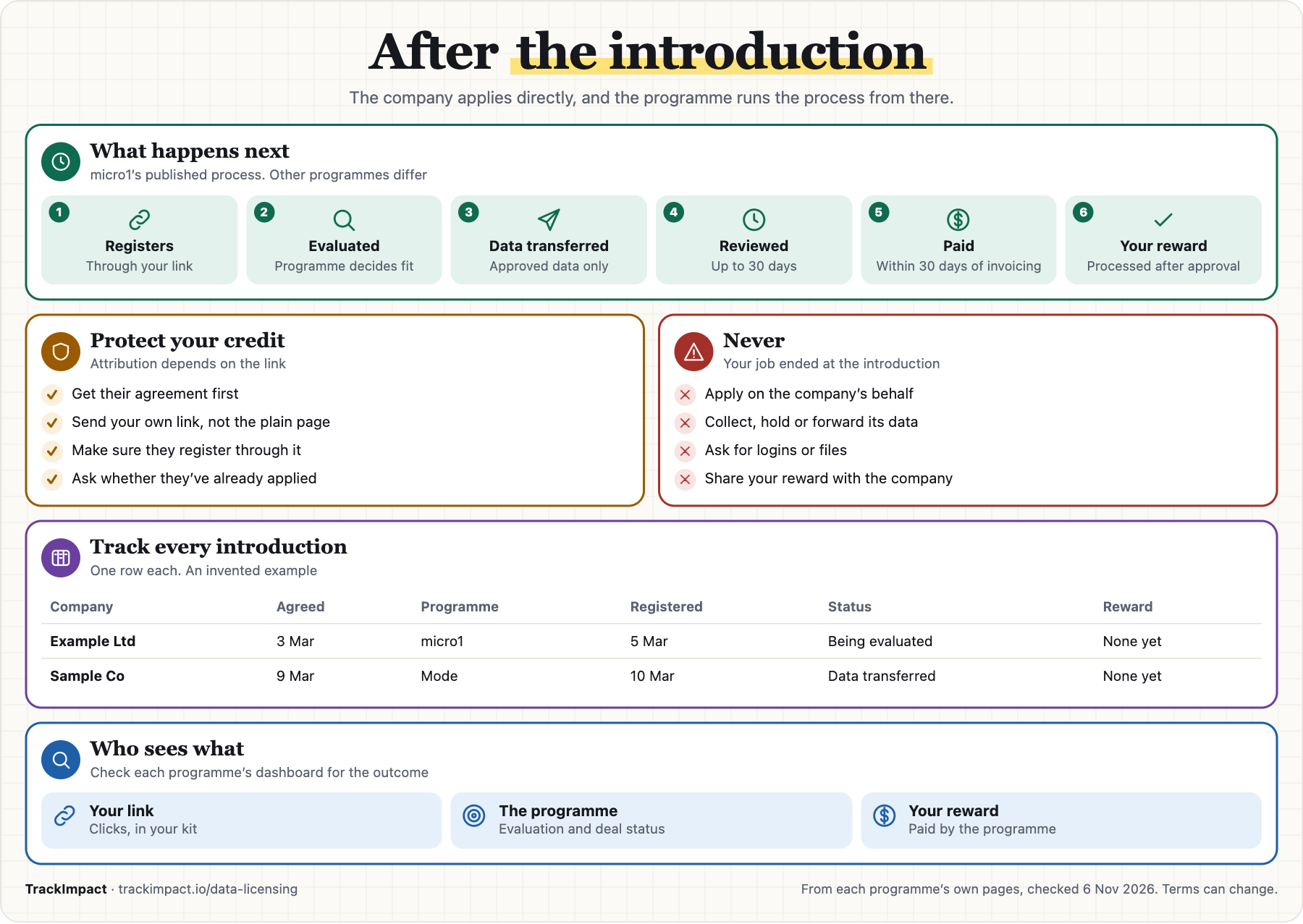
Attribution matters, and it works through a link, not a code. On micro1, you register at refer.micro1.ai, switch to the Company section and copy your unique referral link from the Opportunities tab. The company needs to register through that link: micro1 says it can't change attribution afterwards if a company has already registered independently or through someone else's link. Manual introductions and applications made on a company's behalf don't count.
micro1 processes your reward after the company's data has been transferred and approved, then pays it by bank wire. A company registering, applying or signing doesn't earn a reward on its own.
Check each programme's dashboard for status, because that's the only place the outcome appears.
11Referring companies that have closed (defunct company referrals)
Some programmes also license records from companies that have stopped trading. micro1 publishes a separate reward for these: $75,000 for deals up to $1 million, or 7.5% of the deal value above that. The person to reach is whoever now controls the records, and it's worth reading what happens to a closed company's data first.
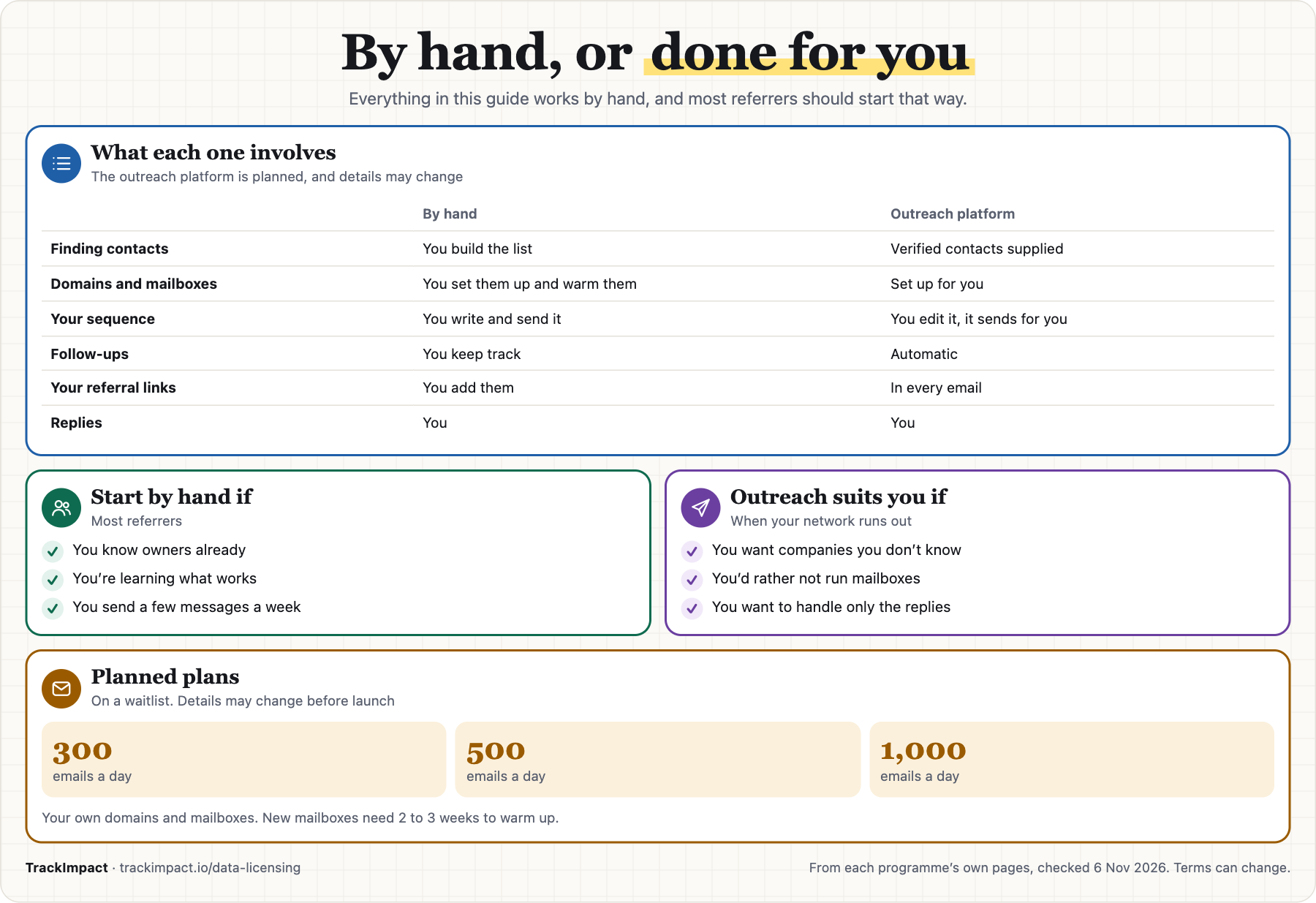
12By hand, or with done-for-you cold outreach
Everything above works by hand, and most referrers should start that way. The limit comes when you want to reach companies you don't know.
Everything in this guide works by hand, and most referrers should start that way.
What each one involves
The outreach platform is planned, and details may change
| By hand | Outreach platform | |
|---|---|---|
| Finding contacts | You build the list | Verified contacts supplied |
| Domains and mailboxes | You set them up and warm them | Set up for you |
| Your sequence | You write and send it | You edit it, it sends for you |
| Follow-ups | You keep track | Automatic |
| Your referral links | You add them | In every email |
| Replies | You | You |
Start by hand if
Most referrers
- ✓You know owners already
- ✓You’re learning what works
- ✓You send a few messages a week
Outreach suits you if
When your network runs out
- ✓You want companies you don’t know
- ✓You’d rather not run mailboxes
- ✓You want to handle only the replies
Planned plans
On a waitlist. Details may change before launch
Your own domains and mailboxes. New mailboxes need 2 to 3 weeks to warm up.
Cold outreach at that scale has four inbox rules, and getting any of them wrong sends your emails to spam without warning:
- Separate domains. Never send cold email from your main business address. If it gets flagged, your everyday email goes down with it.
- SPF, DKIM and DMARC. Every sending domain needs these three records, which prove the email really comes from you.
- Spread the volume. A mailbox should send no more than 30 cold emails a day, so you need several mailboxes across several domains.
- Warm up new mailboxes. They send a little more each day for two to three weeks before inbox providers trust them.
That's why we built Outreach. It buys your sending domains, sets up and warms your mailboxes, supplies verified decision makers at UK and US companies with 30 or more staff, and sends your sequence with your link in every email. Each company goes to one referrer at a time. Interested replies come to you, and you run the conversation. It's a paid subscription, the fee doesn't depend on results, and it's opening in stages from a free waitlist.
13Questions people ask
How does the micro1 company referral program work?
Register at refer.micro1.ai, switch to the Company section and copy your unique referral link. A company that registers through your link is credited to you. micro1 evaluates it, agrees terms directly with it, and processes your reward after the company's data is transferred and approved. Nothing is guaranteed.
Is a micro1 company referral the same as a candidate referral?
No. micro1 runs two schemes. Candidate referrals introduce people for micro1's jobs and pay up to $3,000 per placement. Company referrals introduce businesses that license their records, with micro1's published reward of $50,000 per deal up to $700,000 and 7.5% above that. This page is about company referrals.
Does micro1 use a referral link or a referral code?
A link. The company must register through your unique referral link. micro1 says attribution can't be changed afterwards if the company has already registered on its own or through someone else's link, and manual introductions don't count.
When is the micro1 referral reward paid?
After the referred company's data has been transferred and approved by micro1, the reward goes through payout approval and is paid by bank wire. A reward isn't earned just because a company registers, applies or signs, and micro1 gives no guaranteed timeframe.
Who pays the referral fee?
The programme. It pays the company for its data and, separately, may reward the person who made the introduction. The company never pays the referrer. Anyone asking a company for a fee to get in is a red flag.
Do Mode, Mercor and Handshake AI have company referral programs too?
Mode and Mercor publish company referral rewards, and Handshake AI has a referral page with terms not yet confirmed. Each has its own link, criteria and terms, so join every scheme you plan to use.
Do I need to be a data expert to refer companies?
No. You make an introduction and the programme handles the evaluation, the agreement and the data. You never collect, hold or forward a company's records.
Is a referrer the same as an AI data broker?
The term AI data broker is used online for this work, but a referrer doesn't buy, sell or handle data. You introduce a company, and it deals with the programme directly.
Should I tell a company whether it qualifies?
No. Share the published criteria and the fit check, and leave the decision to the programme. Each one makes its own call.
Do I have to send cold emails?
No. Most referrers start with people who already know them. Cold outreach is one option. It has its own legal rules, and it needs separate sending domains, SPF, DKIM and DMARC records, and warmed-up mailboxes.
Sources
- micro1.ai/company-referral, checked 19 November 2026 · Join micro1’s referral scheme →
- micro1 data partnerships, checked 6 November 2026 · Apply to micro1 →
- micro1 referral terms (updated 14 Oct 2026), checked 6 November 2026
- data.mode.inc/referrals, checked 6 November 2026 · Join Mode’s referral scheme →
- data.mercor.com/refer (per-type listings), checked 4 November 2026 · Apply to Mercor →
- Handshake AI data partnerships, checked 6 November 2026
- FTC: Endorsement Guides, what people are asking, checked 4 November 2026
Our links to these programmes carry our referral code, so the programme can see the introduction came from us. The programme may pay us a referral fee, and you pay nothing.